
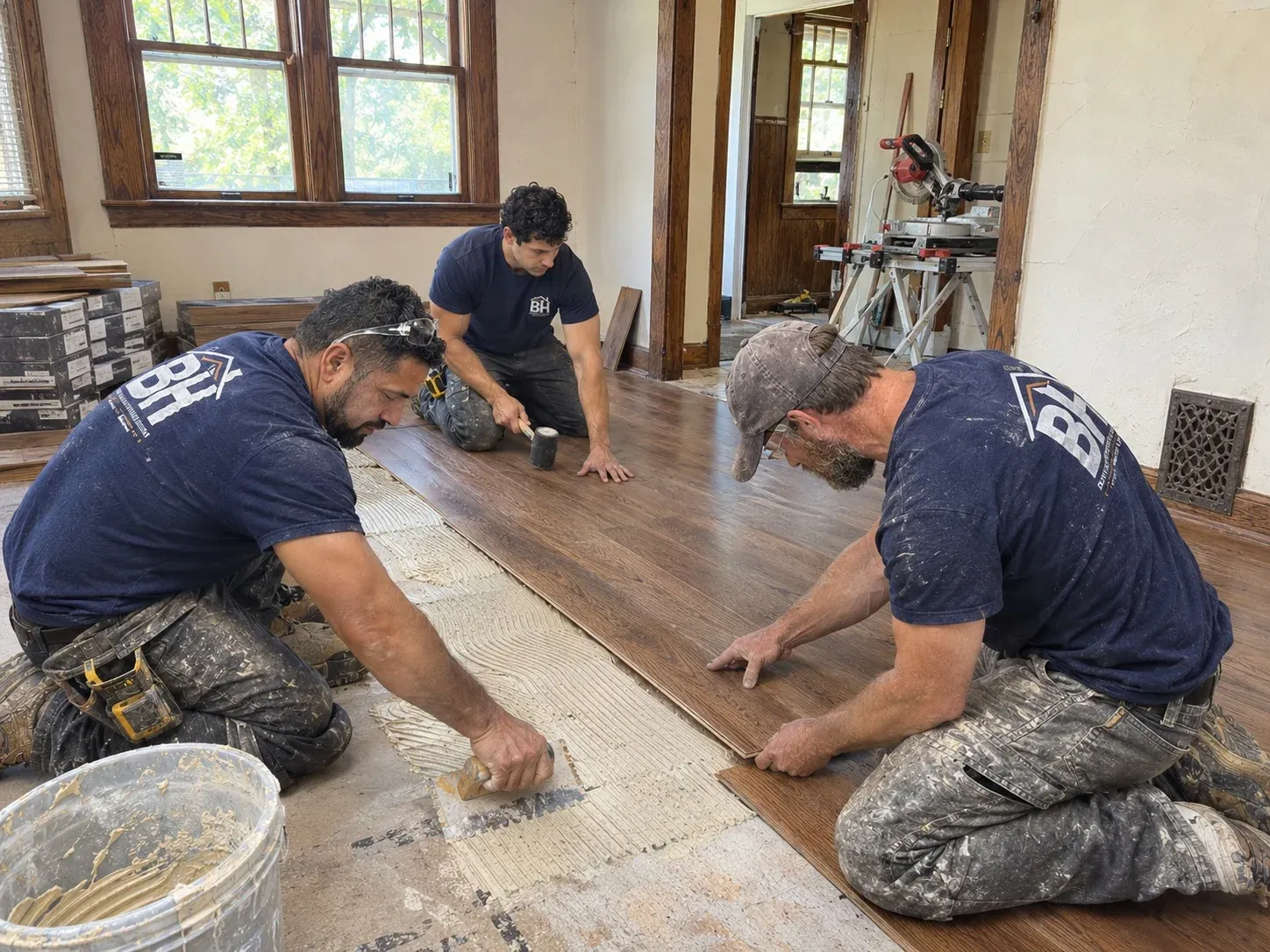
If you own a 1920s Colonial in Shaker Heights, a Tudor in Cleveland Heights or a postwar bungalow in South Euclid, your kitchen floor has seen more history than any other surface in the house. Pull up the worn vinyl, and you may find 1950s nine-inch tiles, black adhesive and, with some luck, original oak waiting at the bottom. Your next floor has to live with all of that, along with a slope toward the basement stairs, a dining room full of 90-year-old oak and a long winter of slush at the back door.
You want a kitchen floor that looks like it belongs to the house, holds up to boots and the dog, and still pays off when the time comes to sell. The right choice delivers all three, while the wrong one can leave you with cracked grout or cupped boards before the second winter ends.
The best kitchen flooring for older homes in Northeast Ohio has to pass tests a new build never faces. Site-finished oak hardwood passes the most of them and earns the top spot for most households. Oak matches original floors, sands flat over old dips and returns the most value at resale. Rigid-core luxury vinyl plank takes the budget crown, and porcelain tile wins for wet entries and heavy wear when the framing below is stiff enough.
Your house has already settled much of the decision for you. How flat the subfloor is, what lies under the current layer, how the kitchen connects to other rooms and how hard winter hits the back door all narrow the field quickly.
What an Older Ohio Kitchen Demands From a Floor
Older homes put kitchen floors through conditions that newer construction avoids. In Shaker Heights, homes built before 1939 make up about 42% of the housing stock, and many of those kitchens share the same four challenges.
Sloping, bouncy framing: Ninety years of settling, notched joists and old plumbing cuts leave many kitchen floors out of level by half an inch or more. Tile cracks where a floor flexes, while wood and vinyl handle small movement well.
Hidden layers below: Many kitchens carry two to four old floors, and some of those layers are better left sealed in place. A floor that can float over an old layer gains a real advantage here.
Original oak next door: Dining rooms and hallways in these homes often keep their narrow oak strips. When the kitchen floor clashes with that oak, the house looks broken into pieces.
Lake-effect winters: Snow, road salt and dry furnace air hit the back door hard from December through March. Water-resistant surfaces and stable materials hold up best through that stretch.
Few floors score well on all four tests, which is why the trade-offs matter. The contenders below handle these challenges in very different ways.
Pro Tip:
Before choosing any new floor, lift a heating register cover or check the floor inside a pantry closet. Original oak often shows at those edges, and finding it early can change the whole plan from replacing to restoring.
The Top Flooring Contenders for Older Kitchens
Older homes have more flooring choices than most owners expect, from restoring the oak already underfoot to cork, stone and modern vinyl. The breakdowns below cover who the floor suits, why it works, what to watch for, what it costs and how long it lasts.
Refinishing Original Hardwood
Sometimes the best new kitchen floor is already in the house, hidden under linoleum, vinyl or plywood. Original oak or maple strips often survive in homes built from the 1910s through the 1950s, and a full sand and refinish brings them back for less than any new hardwood while earning the strongest return of any flooring project at resale.
This option makes the most sense when the boards are sound, thick enough to sand and still connected to the oak in the dining room or hallway. Black adhesive stuck to the wood needs testing before sanding because older mastics can contain asbestos, and gaps left by old cabinets need patching with matching boards.
What to Know | Details |
Ideal kitchen | Sound original oak or maple hiding under old layers |
Price range | $3 to $8 per square foot installed |
Life ahead | Several more decades, depending on the board thickness left for sanding |
Moisture defense | Moderate once a fresh polyurethane finish seals the surface |
Fit with the house | Perfect, since the floor is original |
Final call | The first choice whenever healthy original wood survives underneath |
Site-Finished Oak Hardwood
Walk from an original oak dining room into a kitchen with new oak finished on site, and the floor reads as one surface. Installers weave new 2 1/4-inch strips into the existing floor, sand everything flat and apply one stain and finish across both rooms, which hides the line between old and new. Those finish coats also seal the seams between boards, giving the floor better spill protection than prefinished planks.
New oak suits kitchens that open into rooms with original oak, especially for owners planning a long stay or a strong sale. Sanding levels minor dips in older framing, and real oak draws more buyer interest in older neighborhoods than any printed look. Puddles near the sink, road salt from the driveway and dry January air pose the main threats, though rugs, quick cleanup and a humidifier set between 30 and 50 percent keep those issues in check.
Top match: kitchens beside original oak rooms and owners focused on long-term value
Installed price: $8 to $15 per square foot
Expected life: 75 to 100 years or more with periodic refinishing
Spill protection: moderate, with seams sealed by the site-applied finish
Character match: excellent, blending board for board with original floors
Ranking: overall winner for most older Northeast Ohio kitchens
Few floors give back as much over the life of an older home. Oak sets the standard the rest of this list gets measured against.
Engineered Hardwood
Engineered boards bond a real wood top layer to a plywood core, which keeps them steadier than solid wood through Ohio humidity swings. Thinner profiles of 3/8 to 1/2 inch suit kitchens with tight clearance at the dishwasher or doorway, and floating installs can cover sealed old layers.
Thin wear layers allow only one or two refinishes, and beveled factory edges trap crumbs and water. Prefinished colors also rarely match 90-year-old oak exactly, which makes engineered oak a problem solver for height limits and old layers more than a first choice.
Engineered oak works best in kitchens with tight height limits or sealed old layers underneath.
Installed prices run $7 to $14 per square foot.
Most floors last 20 to 40 years, depending on the thickness of the wear layer.
Moisture handling stays moderate, since beveled edges can hold water.
Real wood suits older homes, even when the color misses the original oak slightly.
Engineered boards rank first among real-wood options when solid oak would raise the floor too much.
Kitchens without height limits or hidden layers usually get more value from solid oak. The rest gain real wood without raising the floor.
Porcelain and Ceramic Tile
Porcelain tile's dense body stands up to water, salt and heavy traffic better than any other floor on this list, while ceramic tile costs less and offers more colors but chips more easily. Busy households with large dogs and a back door that opens straight into the kitchen benefit most, and classic hex mosaics or checkerboard layouts keep the look true to an older home.
Framing decides the outcome with tile, since the floor must meet a deflection limit of L/360 before installation. The build-up adds about 3/4 inch with backer board, and the surface feels cold underfoot unless an electric radiant mat goes underneath. Tile laid over a bouncy floor often shows cracked grout within a few winters.
Factor | Rating | Notes |
Water resistance | 5 out of 5 | Fully waterproof surface |
Durability | 5 out of 5 | 50 years or more over stiff framing |
Comfort | 2 out of 5 | Cold and hard without radiant heat |
Older-home fit | 2 out of 5 | Framing often needs reinforcement first |
Installed cost | $10 to $20 per sq ft | Highest risk of added framing work |
Tile suits busy households with large dogs and a back door that opens into the kitchen, and it wins outright for heavy wear and wet entries.
Natural Stone
Slate, marble, limestone and travertine bring a heavy, timeless look that suits large Tudor and Colonial kitchens. Slate offers natural grip and hides dirt, while marble and limestone add a classic finish that manufactured floors cannot fully copy.
Stone fits owners who love that look and do not mind regular sealing, though the material asks a lot from an older house. Framing needs to be twice as stiff as for porcelain, at L/720, and stone weighs far more than tile. Marble and limestone also etch when lemon juice, wine or vinegar stay on the surface.
Large period kitchens with framing that can be stiffened to stone standards suit stone best.
Installed prices range from $15 to $30 per square foot.
Sealed stone floors can last 75 years to a century.
Water resistance stays high once sealed, though marble and limestone etch from acids.
Heavy weight and strict framing needs make older houses a real challenge.
Stone ranks as a luxury pick for grand period kitchens, not a practical choice for most homes.
Stone gives the right house a look that lasts for generations. In a kitchen with bouncy framing, the price of reinforcement often outweighs the beauty.
Rigid-Core Luxury Vinyl Plank
Rigid-core luxury vinyl plank pairs a stone-polymer or wood-polymer core with a printed wood-look surface, and the planks click together into a floating floor. Quality lines now copy oak grain closely enough to fool a quick glance. Waterproof cores handle slush and spills, the thin profile keeps doorway transitions low, and floating installation covers old layers without a tear-out.
Planks need a base flat within 3/16 inch over 10 feet, and heavy islands should not pin the floor in place. Wide gray planks can also look out of step next to original oak. Rigid-core vinyl makes sense when these statements match your kitchen:
Your budget calls for a waterproof floor at $4 to $9 per square foot installed.
Old tile needs to stay sealed in place without a tear-out.
A lifespan of 15 to 25 years before replacement fits your plans.
Slush, spills and pet accidents happen often enough that a waterproof core matters more than real wood.
Practicality outweighs authenticity, especially in a closed kitchen or rental.
When most of these hold true, vinyl is the budget winner and the top pick for covering old tile. Owners who value authenticity above price still lean toward oak.
Sheet Vinyl
Modern sheet vinyl rolls out in wide pieces with few or no seams, which keeps water from reaching the subfloor and makes it the lowest-cost waterproof option. Its thin profile fits tight appliance heights, and retro patterns suit 1950s kitchens, rentals and laundry-kitchen combos.
The surface does have limits, since sharp appliance feet and dragged chairs can dent or tear it and the look rarely matches original oak in nearby rooms. Those trade-offs make sheet vinyl a short-term choice for budget updates.
Best Match | Installed Cost | Lifespan | Water Resistance | Style Fit |
Rentals and quick budget updates | $3 to $7 per sq ft | 10 to 20 years | Excellent | Fair, suits 1950s kitchens |
Sheet vinyl ranks as the lowest-cost waterproof floor, though it rarely serves as a long-term answer in an older home.
True Linoleum
Linoleum, made from linseed oil, cork or wood flour and a jute backing, was the standard kitchen floor in many 1920s and 1930s homes. Sheet and tile versions bring back that period charm with marbled colors and checkerboard layouts. The material follows gentle dips in the subfloor, resists scratches and feels warmer than tile, which makes it a favorite for restorations and for cooks who want a softer surface.
Linoleum needs periodic sealing to keep stains out, and seams near the sink can swell when water stays on the surface. True linoleum is often confused with vinyl, yet the two differ in material, feel and lifespan.
Made for 1920s and 1930s restorations and cooks who want a softer surface
Costs $6 to $12 per square foot installed
Lasts 25 to 40 years with regular care
Handles moisture moderately, with seams that need periodic sealing
Fits period kitchens better than any other resilient floor
Wins outright for authentic period restorations
Linoleum delivers the most faithful vintage look on this list. Owners willing to reseal it on schedule get decades of character in return.
Cork
Cooks who stand at the counter for hours often fall for cork the moment they walk on it. The bark-based material cushions knees and backs, stays warm through winter and quiets footsteps in open older layouts.
Refrigerator and range feet leave dents, sunny windows fade the color, and the surface needs periodic resealing to keep spills out. Busy kitchens with heavy appliances and large dogs usually do better with oak or vinyl.
What you get: the softest, warmest floor on this list, ideal for cooks and bakers who stand for long stretches
What you pay: about $6 to $12 per square foot installed
What you maintain: periodic resealing for moderate spill resistance
How long it serves: 20 to 30 years with careful upkeep
How it looks: a soft, natural texture that suits relaxed older kitchens
Where it ranks: most comfortable floor here, best in gentle households
Comfort is the main reason to choose cork. Its durability is the reason to think twice in a busy kitchen.
Water-Resistant Laminate
Newer laminate lines pair a dense fiberboard core with sealed edges and a hard wear layer, which handles spills far better than older laminate. The surface resists scratches from pets and chairs better than many wood finishes, and realistic oak visuals cost less than real hardwood.
Long-standing water still damages the core, the floor cannot be refinished, and the hollow sound underfoot feels less solid than wood. Kitchens with frequent leaks or a busy sink area still do better with vinyl or tile.
Strengths | Limits |
Budget wood look at $4 to $9 per square foot installed | Long-standing water damages the core |
Strong scratch resistance against pets | No option to refinish |
Sealed edges handle quick spills | Hollow sound underfoot |
15 to 25 years of service | Rarely matches original oak closely |
Laminate makes the most sense for budget wood looks in homes with active dogs, though it trails vinyl in wet kitchens.
Bamboo
Strand-woven bamboo comes from a fast-growing grass and ends up harder than oak once compressed, which appeals to eco-minded remodelers. Its clean, contemporary grain fits best in modern or fully renovated kitchens with no original hardwood nearby to match.
Quality varies widely between brands, and lower-grade boards can swell or split as kitchen humidity shifts through Ohio seasons. Bamboo's grain and color also rarely blend with original oak.
Bamboo fits when:
the kitchen is modern or fully renovated, with no original hardwood to match
eco-friendly materials matter and the budget allows $6 to $12 per square foot installed
a 20 to 25 year lifespan for well-made strand-woven boards suits your plans
Bamboo misses when:
original oak runs through nearby rooms, since its grain and color rarely blend
the kitchen sees frequent spills or wide humidity swings, which can swell lower grades
For modern remodels, bamboo offers an eco-friendly alternative to oak. Period homes almost always look better with real oak.
Matching new boards to a 90-year-old oak floor takes patience and a careful eye. We plan flooring around the layout and character of older and historic-style homes, from restored oak in Tudor houses to white oak herringbone in updated kitchens. Homeowners keep the charm they bought the house for, and they gain a floor ready for daily cooking and heavy traffic.
How the Contenders Compare Head-to-Head
Putting these floors side by side shows where the best kitchen flooring for older homes separates from the rest. Eight factors decide the matchup in a Northeast Ohio kitchen.
Slush, Spills and Salt
February in Northeast Ohio means wet boots, salty puddles and a dog shaking off snow by the back door. Porcelain tile and rigid-core vinyl take all of it without damage, since water cannot pass through their surfaces. Oak and linoleum depend on their finish, and salt slowly dulls polyurethane while puddles left at the seams can cup wood boards. Boot trays and washable runners narrow the gap, yet tile and vinyl still forgive far more mistakes.
Ohio Winter Tip:
A boot tray and a washable runner inside the back door catch most road salt before it reaches the kitchen floor. Wiping salty puddles the same day keeps white residue from dulling any finish.
Winner: Porcelain tile takes this round, and rigid-core LVP finishes a close second.
Sloping and Bouncy Floors
Old framing rewards floors that can flex. Ranked from most forgiving to least:
Sheet linoleum: follows gentle dips with almost no risk of cracking.
Site-finished oak: nails tight to the subfloor and sands flat at the seams.
Rigid-core LVP: tolerates flex but needs a fairly flat base to keep click joints tight.
Engineered hardwood: handles movement yet shows uneven edges on wavy floors.
Porcelain tile: needs stiff, flat framing to keep tiles and grout from cracking.
Sistering joists makes tile possible in almost any kitchen, though the framing work adds cost before the first tile goes down. Houses with an obvious bounce often get a better result for less money with oak or vinyl.
Most Forgiving: Linoleum and oak handle older framing with the least fuss.
Old Layers Underneath
Many older kitchens hide 9-inch vinyl tiles or sheet flooring with black adhesive from decades past, and some of those materials contain asbestos. Tearing them out adds testing, abatement and cost, while covering them keeps the fibers sealed. Floors that float over the old layer gain a clear edge, because when asbestos flooring needs replacing install new floor covering over it, if possible.
Rigid-core vinyl and engineered wood both float over a sound older layer on new underlayment. Site-finished oak and tile usually need the old layers removed or a fresh plywood base on top, which raises the floor.
Myth vs Fact:
Myth: All old flooring has to come out before a new floor goes in.
Fact: Sound, well-bonded layers can often stay sealed under a floating floor, which saves demolition time and avoids disturbing older materials.
Winner: Rigid-core LVP leads here, with floating engineered wood close behind.
Height at Doorways and Appliances
Total floor height decides the fit at the dishwasher opening, the step into the dining room and the reveal under the cabinet toe kick. Rigid-core vinyl adds about 1/4 to 5/16 inch, engineered wood about 3/8 to 3/4 inch, and solid oak or tile with backer board about 3/4 inch. Removing old layers down to the original subfloor often recovers 1/2 inch or more, which opens room for thicker floors.
Doorways into rooms with original oak look best with a flush transition, since a raised reducer strip catches toes and looks like an afterthought.
Lowest Profile: Rigid-core LVP keeps transitions lowest and fits tight dishwasher openings most easily.
Period Character
1910s to 1930s Tudors and Colonials: Narrow oak strips, small hex tile and checkerboard linoleum fit the original trim and built-ins.
1940s and 1950s homes: Oak, linoleum and simple square tile suit the era, while wide wood-look planks feel more modern.
Updated or mixed-style homes: Wood-look porcelain and luxury vinyl blend in when the rest of the house has already moved to wider planks.
Real oak connects the kitchen to the rest of an older home in a way printed visuals cannot fully match.
Most Authentic: Site-finished oak hardwood fits the original character of the house best.
Comfort Underfoot
Holiday baking, Sunday sauce and long cleanup sessions all happen standing up. Wood and linoleum give slightly underfoot and stay warmer than tile, which runs cold through January unless an electric radiant mat goes underneath. Rigid-core vinyl lands in between, warmer than tile but firmer than wood.
Most Comfortable: Oak and linoleum feel the most comfortable through long hours at the counter.
Installed Cost
Typical installed prices per square foot compare as follows:
Refinishing original oak found under old layers: $3 to $8
Sheet vinyl: $3 to $7
Rigid-core luxury vinyl plank: $4 to $9
Water-resistant laminate: $4 to $9
True linoleum: $6 to $12
Cork: $6 to $12
Bamboo: $6 to $12
Engineered hardwood: $7 to $14
Site-finished solid oak: $8 to $15
Porcelain or ceramic tile: $10 to $20
Natural stone: $15 to $30
Older kitchens often add subfloor repair, leveling or joist reinforcement, which can raise the total by several dollars per square foot. Tile carries the highest risk of added framing work, while vinyl over a sound base stays the lowest-cost new floor.
Best Value: Rigid-core LVP offers the best value for a new floor, while refinishing wins when original oak survives underneath.
Resale Value
Buyers touring older Cleveland-area homes often expect real wood, and wood floors return more of their cost than nearly any other interior upgrade. Among interior remodels, the highest percentage cost recovered was from refinishing hardwood floors at 147%, with new wood flooring close behind. Porcelain tile also holds value well in kitchens, while luxury vinyl appeals more in starter homes and rentals than in historic properties.
Did You Know?
Solid 3/4-inch oak strips can usually handle four to six full sandings over their lifetime. That reserve of wood explains why original floors from the 1920s can still look new after a professional refinish.
Strongest Resale: Oak hardwood pays back the most, especially when the new boards match the original floors.
Choosing the right floor is half the job, since older kitchens often need framing fixes, wall patches and fresh trim paint once the old floor comes up. Our team handles flooring, drywall and painting under one contractor, from the first layout plan to the final walkthrough. Homeowners avoid juggling separate trades, and they keep one point of contact for the whole project.
Which Floor Fits Your Older Kitchen?
Your house, your household and your budget all shift the answer. These real-life situations point to a clear pick.
Kitchens that open into rooms with original oak should get oak too. Weaving new strips into the old floor and finishing everything at once creates one continuous surface that looks like it was always there.
Busy households with muddy dogs, toddlers and a back door that never rests get the most from porcelain tile or rigid-core vinyl. Vinyl skips the framing upgrades tile may need, while tile lasts longer under years of heavy use.
Floors that dip or bounce when someone walks past the fridge favor oak, linoleum or vinyl. Tile can still work in these kitchens, but only after the joists get reinforced.
Homes hiding old 9-inch tiles under the current floor do well with floating vinyl or engineered wood, which covers the old layer without a costly tear-out.
Restorations of 1920s and 1930s kitchens look most authentic with narrow oak strips or true linoleum in a checkerboard pattern. Tight budgets and rental units, on the other end, get the most durable floor for the money from rigid-core vinyl.
Floors to Skip in an Older Kitchen
Some popular floors struggle once they meet older framing and Ohio winters. These four cause the most regret:
Carpet and carpet tile: Grease, spills and salty slush soak in and stay, which makes carpet the weakest kitchen choice in any home.
Standard laminate: Older-style laminate with unsealed fiberboard edges swells when water stays on the surface, and older dishwashers and ice-maker lines can leak without warning.
Wide solid-wood planks: Solid boards wider than about 5 inches cup and gap more with Ohio humidity swings, and they rarely match the narrow strips in older homes.
Thin peel-and-stick vinyl: Thin tiles show old seams and dips through the surface and lift at the edges near the sink and back door.
These floors can look appealing in a showroom, yet older framing and long winters expose their weak points quickly. Steering clear of them keeps the budget focused on floors built to last.
The Verdict: Best Kitchen Flooring for Older Homes
Site-finished oak hardwood ranks as the best kitchen flooring for older homes across most of Northeast Ohio, winning or sharing four of the eight head-to-head factors. Rigid-core vinyl takes three, porcelain tile takes one and linoleum shares two, yet the factors oak wins matter most over the life of an older home.
Why Oak Takes the Top Spot
Oak is the only contender that improves the house around it. New strips woven into original floors erase the line between kitchen and dining room, and buyers of older homes notice that continuity the moment they walk in.
Longevity also favors oak by a wide margin. A site-finished oak floor can last 75 to 100 years with periodic refinishing, while rigid-core vinyl typically lasts 15 to 25 years before replacement. Over the life of the house, vinyl may need replacing three or four times, which shrinks its upfront price advantage considerably.
Oak also forgives the quirks of older framing, since sanding flattens small height differences and nails hold the boards tight to an imperfect subfloor.
When Another Floor Wins
Oak is not the right call in all older kitchens. Another floor takes the lead in these situations:
Old asbestos-era tiles staying in place: floating LVP or engineered wood covers them without a tear-out.
A back door that opens straight into the kitchen: porcelain tile handles daily slush and wet dogs best.
A tight budget or timeline: rigid-core vinyl installs fast and costs the least per square foot.
A true period restoration: linoleum recreates a 1920s or 1930s kitchen most faithfully.
These exceptions cover a real share of older homes, which is why the subfloor and layout deserve a close look before any decision. Mixing floors also works well, such as porcelain tile at the back entry and oak through the rest of the kitchen.
Runner-Up Picks
Best budget pick, rigid-core LVP: Waterproof planks with a low profile suit tight budgets, rentals and floors covering old tile. Choosing a narrow, warm oak-look plank gives the most convincing result next to original trim.
Best for heavy wear, porcelain tile: Tile wins for wet entries, large dogs and heavy cooking once the framing is stiff enough. Wood-look porcelain planks or classic hex mosaics keep the style in line with an older house.
Best for tight height limits, engineered oak: Engineered boards bring real oak into kitchens where dishwasher clearance or doorway height leaves little room, though they offer fewer refinishes.
Best period look, true linoleum: Marbled sheets or checkerboard tiles restore the charm of a 1920s or 1930s kitchen. Regular sealing near the sink keeps linoleum looking fresh for decades.
Is Hardwood a Smart Choice for a Kitchen Floor?
Yes, especially in older homes where oak already runs through the house. Modern site-applied finishes resist daily spills, and the floor can be sanded and refinished when wear shows. Rugs by the sink and quick cleanup of standing water handle the main risk.
Does Luxury Vinyl Look Out of Place in a Historic Home?
Luxury vinyl can look out of place when wide gray planks meet narrow original oak at a doorway. Choosing a warm, narrow wood-look plank or using vinyl only in a closed-off kitchen keeps the look consistent. Real oak still delivers the most authentic result in a historic home.
Choosing a Floor That Respects the House
Older Northeast Ohio kitchens need floors that handle sloping framing, hidden layers and long, salty winters while still matching the character of the house. Site-finished oak hardwood wins for most homes, thanks to its seamless match with original floors, its ability to be refinished and its strong resale value. Rigid-core vinyl suits tight budgets and kitchens with old layers underneath, while porcelain tile fits busy, wet entries once the framing is reinforced. The final pick still depends on what lies under the current floor, which is why a close look at the subfloor comes before any sample board.
That close look is where BH General Contractor begins every kitchen flooring project. The locally owned team is fully licensed and insured, handles permits and inspections, and backs its remodeling work with a 10-year warranty. Homeowners across Shaker Heights, Cleveland Heights, Beachwood, University Heights, South Euclid and Pepper Pike receive a detailed estimate before work starts, and they understand the full scope before the first board comes up. Book a kitchen flooring walkthrough with BH General Contractor and find out which floor your older home is ready for.
FAQs
Red Oak or White Oak for a Kitchen Floor?
White oak resists moisture better than red oak thanks to its closed grain, which suits kitchens. Red oak matches many original Cleveland-area floors, and checking the existing species before ordering keeps new and old boards blending seamlessly.
What Tile Size Works Best on an Older Kitchen Floor?
Smaller tiles, such as 2-inch hex or 12-inch squares, handle slightly uneven older floors better than large-format tiles. Large tiles over 15 inches need very flat subfloors, and older kitchens often require extra leveling before they work well.
What Wear Layer Should Kitchen LVP Have?
Choose a wear layer of at least 12 mil for a kitchen, and 20 mil for homes with large dogs or heavy traffic. Thicker wear layers resist scratches from chair legs, dropped pans and grit tracked in from snowy driveways.
Should the Kitchen Floor Run Under the Cabinets?
Yes, for solid oak, tile and glue-down floors, since running under cabinets keeps heights even and allows future layout changes. Floating floors like LVP and laminate should stop at the cabinets to expand and contract freely with the seasons.
What Floor Color Suits an Older Home Kitchen?
Medium natural oak tones suit most older homes, since they match original trim and floors from the 1920s through 1950s. Very gray or very dark floors date faster and show dust, crumbs and salt residue more clearly in busy kitchens.